|
Our calls for information have led to the rediscovery of some unexpected treasures which have been found in the personal archives of several people. During the exhibition period, one of our City of Culture volunteers showed us a poster (pictured below) which had been hanging on her wall for years. It shows Messrs Wolfenden and Melbourne’s "Gala, Tea Party and Ball" at the Zoological Gardens in Hull on 22 July 1861, which featured performances from many artists. 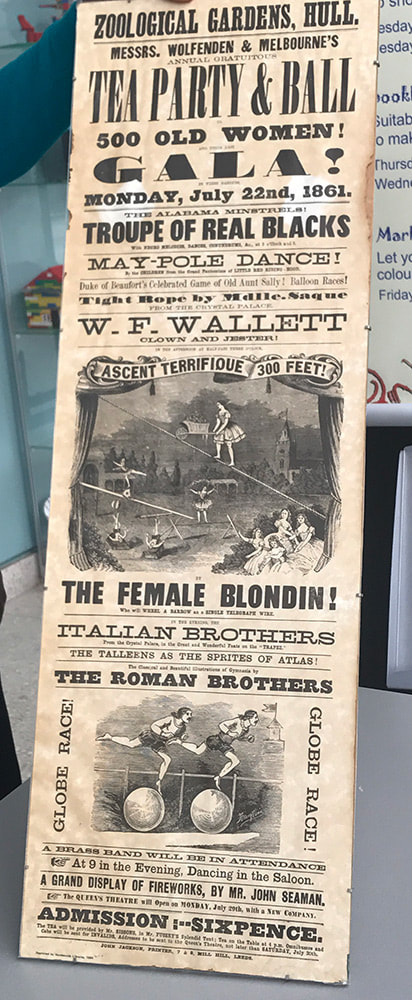 Poster for Messrs Wolfenden and Melbourne’s "Gala, Tea Party and Ball" (click image to enlarge). The poster shows that the day of entertainment included the Alabama Minstrels - a "troupe of real blacks" advertised to perform "negro melodies, dances and conundrums." Further research shows that people of African descent were part of this minstrels group and were not white men in the 'blackface' makeup that had become reasonably popular in this period. [1] The Alabama Minstrels again returned to Hull the following year. They performed at the Queen’s Theatre, Paragon Street on 19 December 1862. [2] If this poster had not been shown to us, it is likely that the presence of these entertainers in the city would have lost. More recently, our thanks go to Mike Wilson (a local history enthusiast from Bridlington), for sending us the article below about the Brandesburton Pygmies which featured in the small local magazine, Around the Wolds, in the early 1990s. He came across this after hearing about our request for relevant material and sent it to us so we could add the article to our Pygmies archive (read more about the Brandesburton Pygmies here). 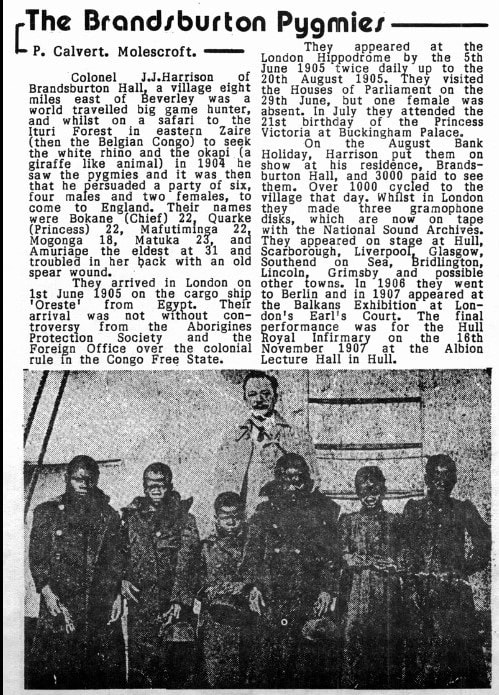 The Brandesburton Pygmies feature in Around the Wolds magazine (click image to enlarge). We would also like to thank Ian Broad and Audrey Dewjee who supplied us with a wonderful image (below) of children from the Bailey and Biggs families following our Children’s Homes blog. This photograph was taken c.1924 at a Board of Guardians children's home in Linnaeus Street, Hull. It shows Miss Trevisani (a foster mother) with an unknown baby on her lap, then, from left to right standing up, Frank Bailey; Tommy Biggs; Maggie Biggs; Lilian Bailey and Jim Bailey. 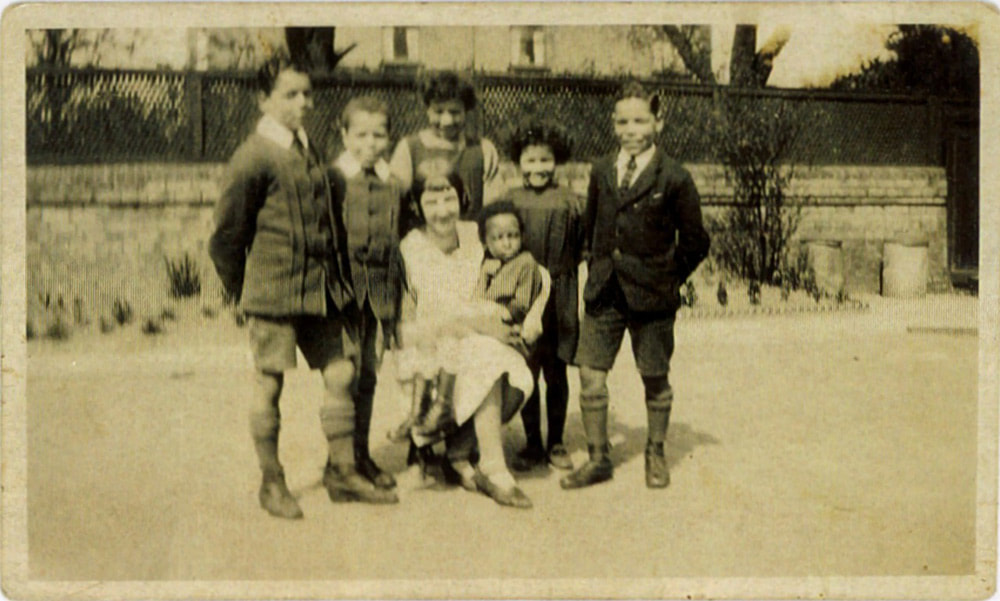 Miss Trevisani and an unknown baby in front of five of the Bailey and Biggs children (L to R: Frank Bailey; Tommy Biggs; Maggie Biggs; Lilian Bailey and Jim Bailey) (click image to enlarge). You never know where you will find something that would be useful to our project. After a casual glance through old local history book Life in Old Hull by Mike Ullyat, we found a gentleman (possibly a circus performer) at Hull Fair in 1911. [3] This image was originally supplied by Ted Dodsworth. We would love to know more about the gentleman in the photograph so if you have any further information please submit it to us via the website here.  Image of circus performers found in Mike Ullyat's book, Life in Old Hull. Photographs, videos, event memorabilia, magazines and newspapers are all vital to uncovering Black history in Hull and East Yorkshire. Please take a moment to look through your collections and get involved with our project. If you have any information which you think may be useful to our project, please contact us. Footnotes
0 Comments
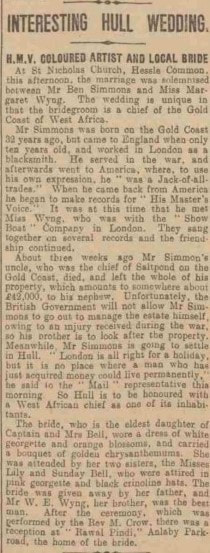
On 25 September 1929, the Hull Daily Mail published an article entitled ‘Interesting Hull Wedding: H.M.V. Coloured Artist and Local Bride’ about the marriage of Ben Simmons and Margaret Wyng that took place at St Nicholas Church, Hessle Common. [1] While the bride was a local woman born in Hull, their wedding was described as, “unique in that the bridegroom is a chief of the Gold Coast of West Africa.” [2]
In August 1929, a month before their wedding, Wyng was given the opportunity to record African American-style spirituals for Imperial Records. [4] The following week, Simmons was made aware that he was the Chief of Saltpond, which was located in the Gold Coast, after his Uncle had died and left him a fortune of around £42,000. However, despite their sudden good fortune, the couple decided to settle in Hull. They could not migrate to Africa to live on their estate because of a wound Simmonds received during his time in service, and they both agreed that London was better as a holiday destination rather than a permanent residence.
Sadly, their marriage did not last long as in 1935, Margaret went on to marry James T Newman in Liverpool. What happened to Simmons remains a mystery. If you have any further information about either of these fascinating characters, please contact us. Footnotes
In the late nineteenth century, various charitable organisations opened institutions for orphaned children in Hull and the city’s surrounding areas. They ranged from small properties which housed only 10 children to large homes which accommodated over 100. Most of these establishments were long term fixtures in the region and did not close until the second half of the twentieth century. However, although many of the children’s homes finally closed their doors in living memory for many locals, we have limited information about the children of African descent who were part of their history. 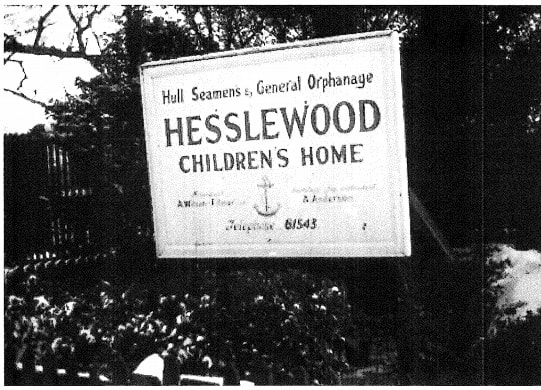 One of the first children’s homes in this area was also one of the most memorable. In 1862, ‘The Port of Hull Society for the Religious Instruction of Seaman’ rented a house in Castle Row to accommodate children who could not be looked after by their families for various reasons. Five years later, a donation of £5,000 from Sir Titus Salt, enabled the Society to buy a larger property, Thane House, which was situated on Park Street and could accommodate 150 children.[1] It was later extended, in the 1870s to house a further 70 children bringing its total capacity to 220 boys and girls. Towards the turn of the twentieth century, the Society purchased an extensive piece of land on Cottingham Road to build a small community for orphaned children. As many locals may remember, in total 10 cottage homes were built and a swimming baths, school and hospital were all located on site. In each cottage, there were around 25 children who were cared for by a house mother (or Governess). Although it has been difficult to find individual names of people who were placed in this establishment, there were many seafarers of African descent in Hull and East Yorkshire, some of whose children will have ended up in this home. The video clip entitled ‘A Family Affair’ from the Yorkshire Film Archive shows a child of African descent in the garden (4 minutes and 45 seconds) and later in the nursery (11 minutes and 31 seconds) of Newland Cottage Homes in the 1960s.
Much like the Newland Homes, the Hessle Cottage Homes located on Hull Road, Hessle were also built in the 1890s. Very little is known about this institution other than it housed around 100 children and was still running in 1962. Based on personal testimonies we know that there were at least three Black children, one girl and two boys from the same family in Hessle Cottage Homes during the 1940s. Four years after ‘The Port of Hull Society for the Religious Instruction of Seaman’ had established a children’s home in Castle Row, ‘The Mariners’ Church Orphan Society (later renamed the ‘Hull Seaman’s and General Orphan Society) opened an Asylum and School on Spring Bank for orphans born within, or connected to Hull (including places like Bridlington, Grimsby and Goole). By 1911, the home could accommodate 200 children. However, in the 1920s, the Society bought and relocated the orphans to the larger premises of Hesslewood Hall (see pics above and below) which did not close until the 1980s. The Ali family were placed here during the 1950s and remember two other children of African descent living at Hesslewood House at the same time as them (click here to read the Ali family’s story). 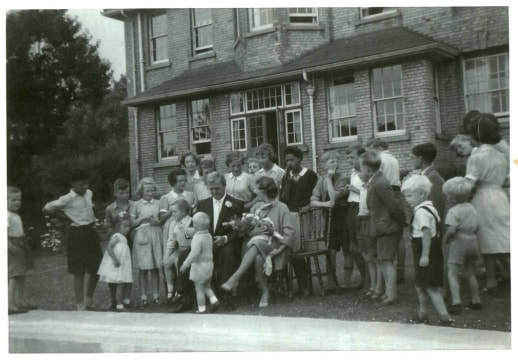 Hesslewood Children's Home c.1958-9 Unfortunately, although we have found a few examples of boys and girls of African descent in Newland Homes, Hessle Cottage Homes and Hesslewood House, there are several other institutions that may possibly have housed children with Black heritage. These include:
Although, some of the census information is available for a selection of the children’s homes identified above, it has been difficult to prove that any of the boys and girls who were admitted had African heritage. In addition to the difficulty of identifying children of African descent in the census, the imposed 100-year closure rule on documents relating to individuals who were placed in the care system to protect their anonymity, only allows us to investigate the patchy surviving records of institutions before 1918. Therefore, for more recent information we must rely on oral history and personal testimonies. If you have any information about boys or girls of African descent who lived in a children’s home in Hull or East Yorkshire please click here to contact us. We really need your help to reconstruct a narrative of the lives of children who lived in these institutions. Footnotes
[1] Sailors’ Orphan Homes, Kingston Upon Hull, East Riding of Yorkshire, http://www.childrenshomes.org.uk/HullSailors/ accessed 10/01/2018 The African Stories in Hull and East Yorkshire project team would like to take this opportunity to say a very Happy New Year to everyone who has helped, supported and followed our project in the last eighteen months. We would also like to inform you of some changes that will be taking place to our schedule and remind you of the next ‘Our Histories Revealed’ exhibition. Schedule
From this week, we will be releasing a new story every Monday and a blog every Thursday. Don’t worry if you miss anything because we will also be uploading our ‘What’s New' blog on a Friday which you can check here. Our Histories Revealed: Exhibition at the Beverley Treasure House Between Saturday 5 May and Saturday 30 June we will be showcasing some of findings in an exhibition at the East Riding Treasure House, Beverley. There will be associated events during the period of the exhibition, including:
For more information, please see pages 14 and 15 of the Treasure House exhibitions and events brochure - download here. For information on where to find the East Riding Treasure House in Beverley and its opening hours, please visit the East Riding website here. If you would like to get involved in our project or our exhibition, please contact us. Download our Our Histories Revealed flyer [104 kb]. This has been an exciting year for the Africans in Hull and East Yorkshire project team. We have worked hard over the last twelve months to deliver a story, blog and short ‘What’s New’ piece every week, an exhibition and several public engagement events. Below is an overview of what we've been up to in 2017, we hope you enjoyed it as much as we did! R E S E A R C H
worked in Hull and East Yorkshire between 1750 and 2007. These include a runaway slave who settled in this region (click to read the story of Frederick Brown), a man who was down on his luck and tried to commit suicide (click to read the story of James Philadelphia Moore), people who contributed to the local entertainment industry (click to read our blog post about Leon Riley) and those who settled here and had families (follow the link from Stories Archive to Family Histories above). In particular, the eleven personal histories and family stories we have received has shown generosity and a willingness to engage which has generated a lot of positive responses. These have been supplemented with the 30 oral histories and the associated transcriptions which have been completed this year and have ultimately contributed to giving us a true reflection of what life was really like for people of African descent who lived and worked here throughout the centuries.
post which will take you to various stories). Through prior historical research we knew that this was the case in other areas with larger Black populations such as London, yet Black soldiers who signed up to join the East Yorkshire Regiment have remained unknown until now. We have new stories of Black soldiers in the East Yorkshire regiment coming out in the New Year so make sure keep up with all our releases via our What’s New blog. P U B L I C E N G A G E M E N T This year has been packed with public engagement events. As a result, we have had a wide range of people who have participated and engaged with our project including children, adults, local historians and academics. Engaging diverse groups would not have been possible without the generosity of a long list of people who have helped us by volunteering, completing administrative tasks or spreading the word about our project. A massive thanks to everyone who has taken part!
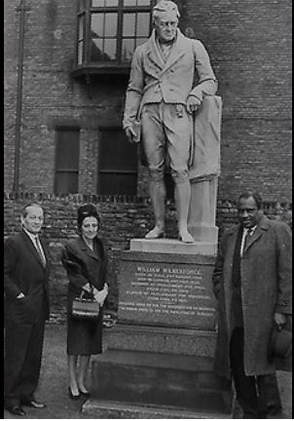
as the families of those who featured in the exhibition, the Ghanaian High Commissioner, the Lord Mayor of Hull, William Wilberforce and several councillors for this area. Click the links to take a look at our exhibition photographs and the fantastic comments we received and take a look at our Media Page to see how tv and newspapers reported the project and exhibition. Events Connected to the Exhibition The opening night of our exhibition was attended by over 100 people who had supported the project in one way or another. It was fantastic to see everyone who had made the exhibition possible all in one place sharing this unbelievable achievement. During the exhibition we held two events, one which was aimed at school children and the other at adults. Both were a success and were very well received. Click our exhibition and events roundup blog post for more. 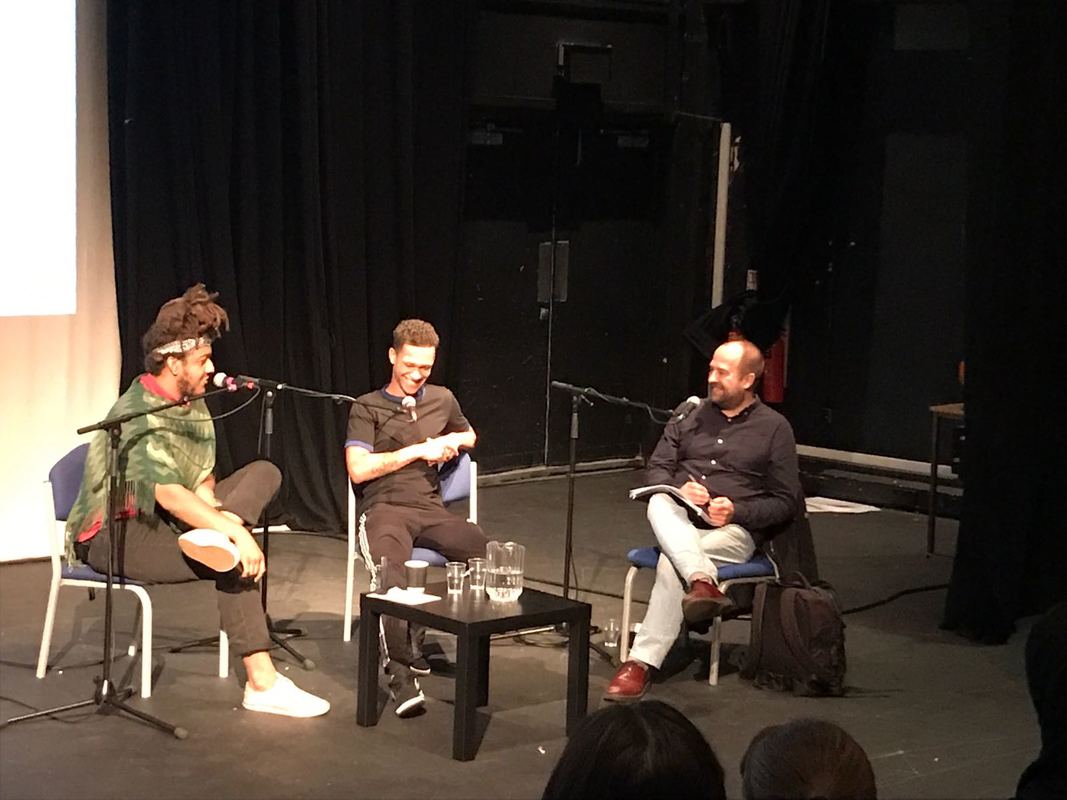 Our 'Schools Event' featured local band Bud Sugar speaking to Jerome Whittingham Public Talks and Conferences This year we have attended and spoken at a range of events to tell people about our exciting project and to share our findings. We have been keen to showcase all the information and provide advice to individuals/other projects because we hope that it will inspire more people to get involved in Black history. In March, we attended the What’s Happening in Black British History Conference and spoke about Black sailors and their experiences in Hull and East Yorkshire before, during and after the First World War. This was followed by a Heritage Open Day event in September, where we delivered a paper entitled ‘African experience in Hull and East Yorkshire'. In October, we delivered a taster session at Hull History Centre’s lunchtime club to showcase some of our findings. More recently, in November we were invited to speak as a panellist at the Engage Conference which is an annual event that brings together arts and education professionals from across the United Kingdom and wider afield. This year's focus was an exploration of diversity, equality and access. Taking part in all of these events has demonstrated how important projects which include diverse and often forgotten histories are in shaping the future. The Project in the Media Over the last twelve months the project has received a lot of attention from the media allowing us to have a constant TV, radio and online presence. This has enabled us to reach audiences on a national and international level. We have featured on Estuary TV, BBC radio and TV, ITV as well as articles in various online magazines and podcasts. To watch, listen or read some of our media broadcasts click Project in the Media 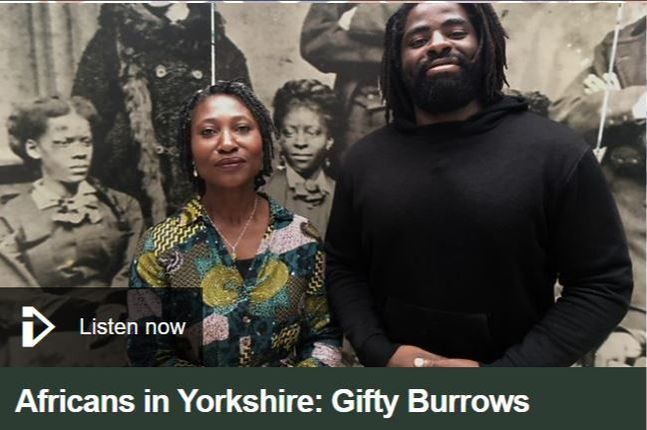 Our Project Lead Gifty Burrows spoke to Kofi Smiles for the BBC's coverage of the Hull City of Culture 2017 T h e P r o j e c t i n 2 0 1 8 Unfortunately, we only have around five months left of our project because it ends in May 2018. However, we have ambitious plans right up until we finish. We have a list of stories and blog posts that we will be releasing including pieces on seaside resorts and criminality among many others. We are also planning for our exhibition at Beverley Treasure House in May and the fantastic events which we are organising to run alongside it. These include opportunities to meet the project team, engage with Black history and learn something new about East Yorkshire. We would like to end our round up of the year with a huge THANK YOU to you for following and engaging with our project. We hope to see you in 2018!
We are always looking for new discoveries; whether it is about a person, a theme on the website or a place that connects many people of African descent, this all helps the project to grow and helps us to produce interesting pieces for everyone to enjoy. East Yorkshire Research and our Forthcoming Beverley Treasure House Exhibition Last week we were contacted through our website and were given the name of another Black soldier who joined the East Yorkshire Regiment during the First World War. This has not only provided us with potentially another story but also adds to our understanding that the East Yorkshire Regiment may have been more diverse than previously thought. This is particularly important considering that next year is the centenary of the end of the First World War and everybody who fought deserves to be remembered. However, this gentleman’s story could be particularly useful for our forthcoming Beverley Treasure House exhibition in May as he was predominantly based in East Yorkshire. We hope to include new stories in our May exhibition with a focus on those people who have lived, worked or visited East Yorkshire. We are currently researching performers of African descent seen at coastal resorts such as Bridlington, Scarborough, Filey, etc. If you remember hearing about or going to see an event, which included Black men and women we would welcome any details so please click here to contact us.
Submitting Information to the Project
Please click here to submit information or to contact us if you think you can help. We would also be grateful if you would share your knowledge or look through your old photograph collections or any memorabilia you may have. You may be surprised by what you find! Also, don’t forget if you are particularly interested in a story, please revisit the page as you never know what you might have missed. Thanks to Mike Covell, John Ellis, Deborah Crawford and Jeff Green for getting in touch. Below are two paintings believed to be by the popular local artist John Ward (1798–1849) who was one of the leading marine and ship painters during the early nineteenth century. Although, they appear to be very similar there is one important difference, can you work out what it is? 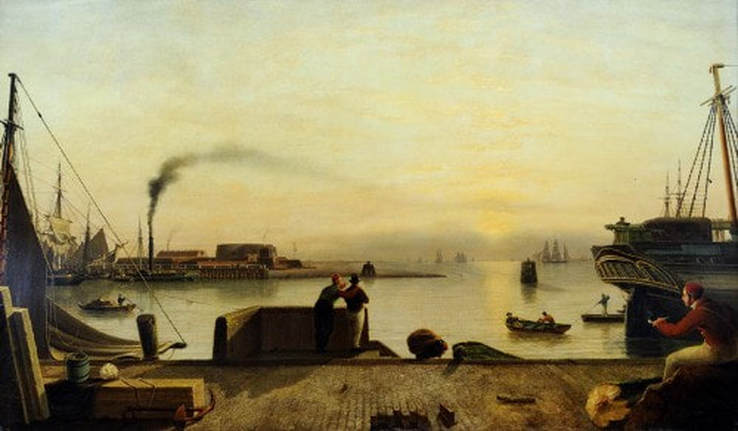 'View of the Humber No.4: The Citadel and entrance to the Old Harbour', Maritime Museum, Hull. M/F1/Merchant Shipping Room 2, KINCM.2007.1010 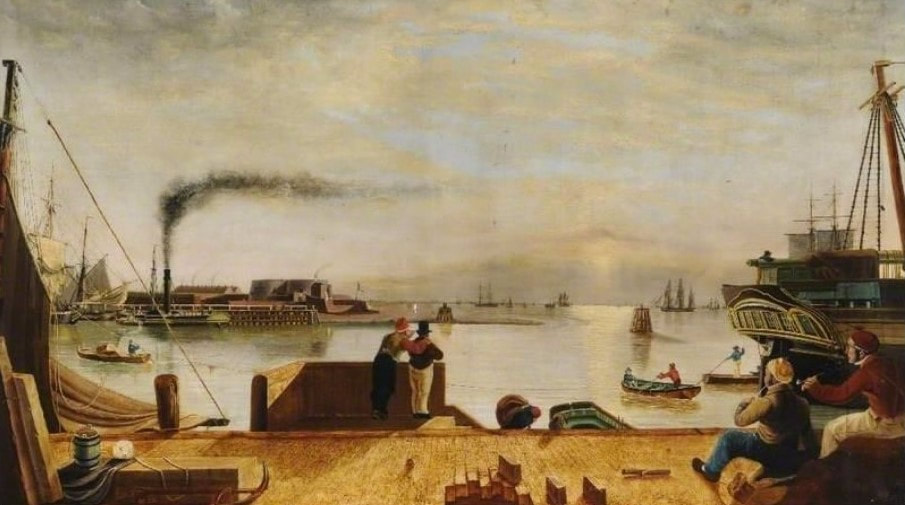 'Shipping Hull Garrison', Hull Museums, Not currently on display, KINCM:2006.9336 Both paintings are set at the mouth of the River Hull and Humber shipping lane at sunrise with a view of steam and sailing ships in the background. Also featured in the paintings are lightermen rowing their small boats out into the river and two men in the midground looking out across the water, in what appears to be deep discussion. However, in the foreground of the picture there is a subtle but important difference. In the first painting, one man in red (possibly a dock worker), is seated on a rock or large piece of wood and appears to be smoking a long pipe. However, in the second painting this man is joined by an acquaintance who is seated to his left. The other gentleman is Black. He is wearing a yellow hat and light-coloured jacket with blue trousers and black shoes. He is also probably a dockworker and is smoking the same long pipe. Thus, while the first image shows an idyllic traditional and popular view of Hull’s maritime landscape in the early nineteenth century, the second painting represents a more faithful and accurate portrayal of actual Black presence within the port.
Undoubtedly, the paintings raise more questions than answers. It is believed that the second picture with the inclusion of the Black sailor was painted around 1800. If this is the case, then it could not have been painted by Ward since he would have only been two years old at the time. Given the scenery and artistic style of the work, it is possible that this early date is incorrect and that, in fact, Ward produced this work much later on. The first painting without the Black sailor has been dated to around 1835 and is believed to be by Ward. This begs the question whether Ward made a copy of the older picture (perhaps by an unknown artist) and then deliberately removed the Black figure? Or did he make a copy of his own painting and add the man into the scene later on? And if so why remove or add a Black dockworker? Additional historical research and pictorial analysis would need to be done in order for these questions to be more fully answered. Nonetheless, the paintings and their story remain intriguing. With thanks to Dr Nicholas Evans for bringing this to our attention. If you think you have any further information about either of these painting, please do contact us here.
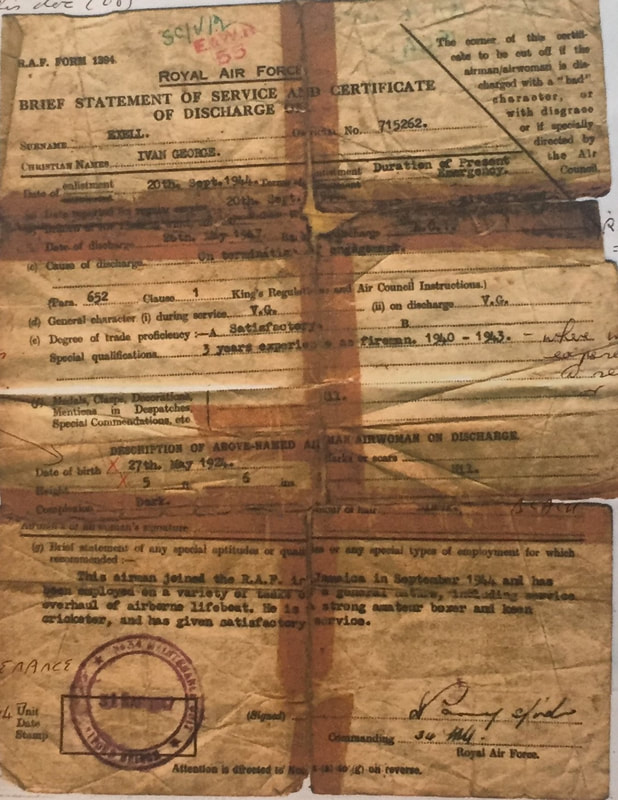
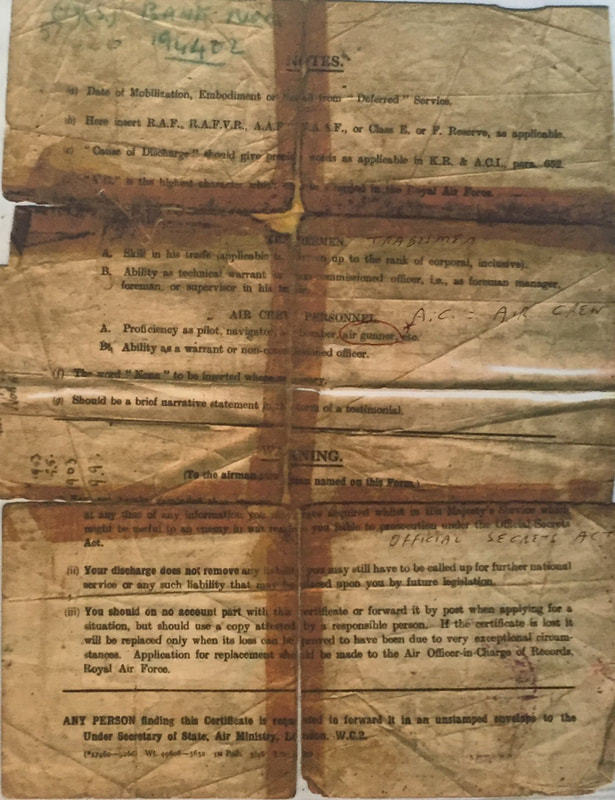
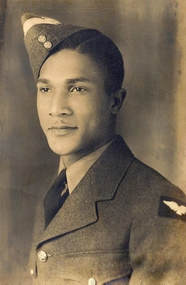
After he had been discharged from the RAF on 31 March 1947, Exell made his way to Hull.[3] During his service, he met the founder of the Boyd Line’s son, Thomas Boyd Senior, who had promised the West Indian a job after the war. True to his word, Boyd offered Exell a position onboard a trawler as a fireman and trimmer.[4] This was not unusual as Black sailors were typically given unskilled jobs in the engine room of vessels (click here to read about Black sailors in Hull). Within a short time, Exell decided that he wanted to become a ship’s cook instead of a fireman and trimmer. Thus, he attended the Nautical College in Hull and passed his examinations in March 1952.[5]
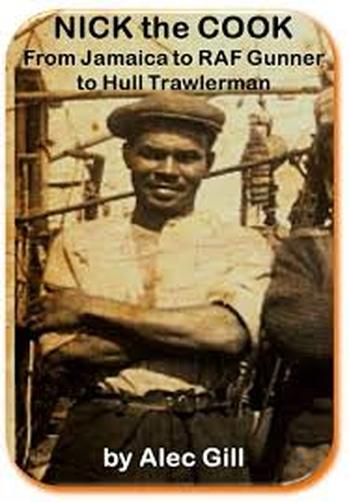
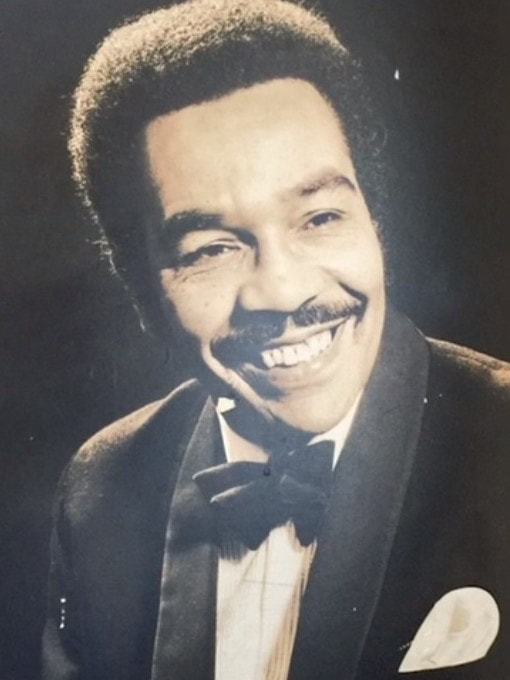
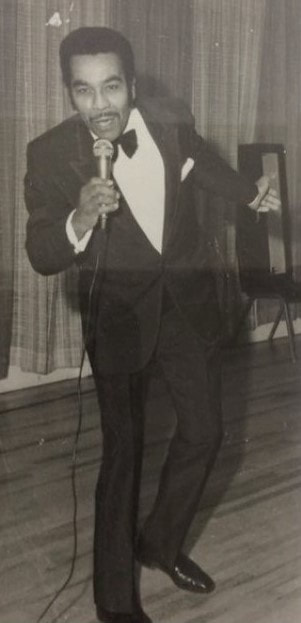
In the 1950s, the Jamaican settled in William Street, Hull and invited his brother to join him in the city. McFarlane was an electrician and thus when he arrived in this region, he gained a job as an engineer at Masscold, the commercial and industrial refrigerator company.[6] One day when he was installing a refrigerator at the Quality Fish Shop on Hessle Road he met Pam, who he thought would be a perfect match for his brother. McFarlane was right as Pam eventually became Exell’s wife.[7] Eventually McFarlane left his career behind as an electrician and followed in his brother’s footsteps becoming a ship’s cook. However, this change of profession led to McFarlane’s untimely death in 1959. On 23 August at 1:30 am the trawler he was working onboard, Staxton Wyke collided with the superior sized ore carrier, Dalhanna.[8] Within 90 seconds the trawler had sank.[9] However, remarkably out of 21 crewmen only five men perished - sadly one of them was Exell’s brother. Gill lists the lost sailors as Norbert William Perrins, Albert Triffett, Anthony Wardle, McFarlane and his assistant cook, Donald Wilde.[10] Exell had no idea about the tragedy as he was on board the trawler, Arctic Buccaneer.[11] 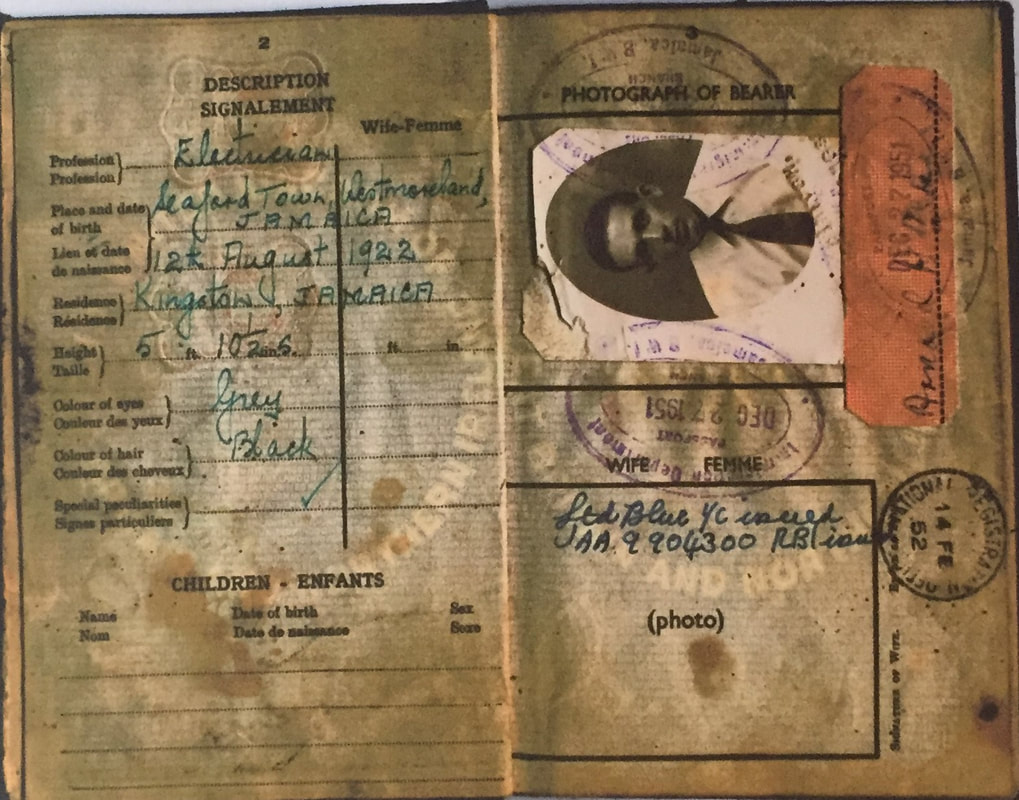 Arnold Alford McFarlane passport However, when he disembarked, the Pastor of the Fishermen’s Bethel, Tom Chappell gave him the sad news of his brother’s passing. Exell rang his mother, who was living in New York, to tell her what had happened to McFarlane. Devastated and angry she paid a Hull solicitor to seek compensation for her son’s death. However, she eventually dropped the case.[12] Exell named his second child Arnold in memory of his brother. More recently, in November 2014, a plaque commemorating Hull’s lost trawlers, including the Staxton Wyke, was unveiled in Rayner’s pub in Hessle Road.[13] 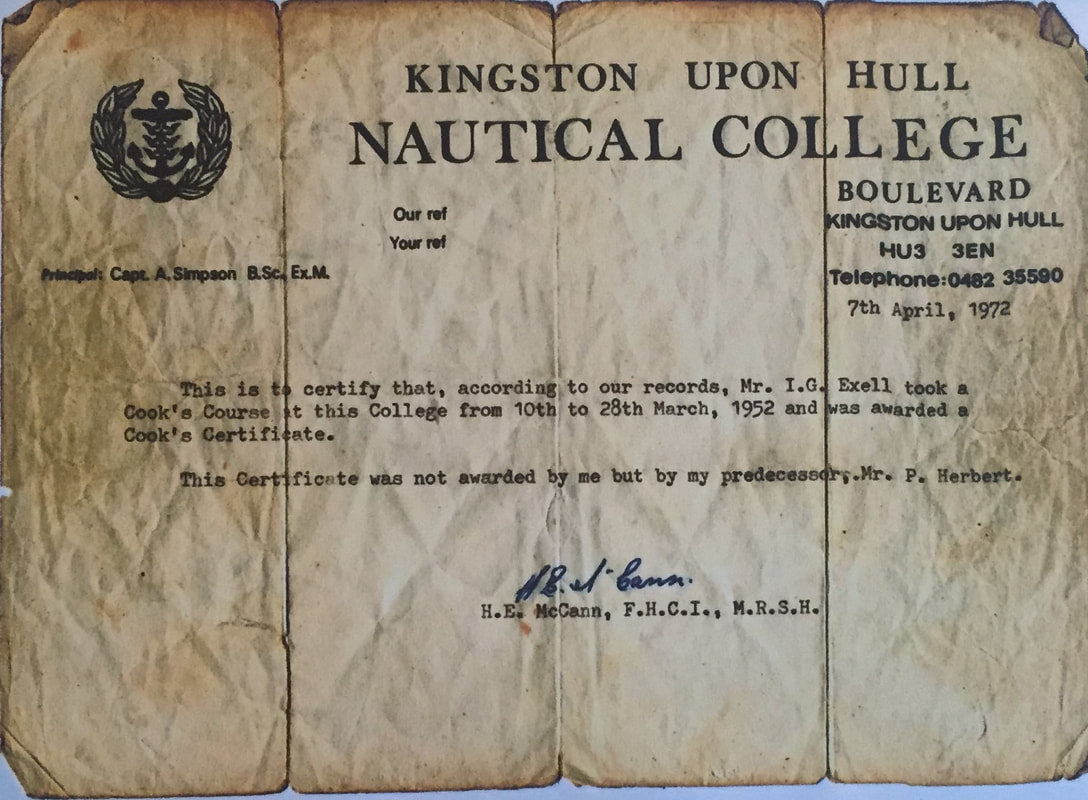 Exell's Nautical College certificate In 1964, the Black sailor retired from work onboard trawlers and instead obtained a position as a Cook Steward on board tugs with the United Towing company.[14] However, although Exell loved his new job, he spent a lot of time away from his wife and three children, who he missed terribly. Sadly, Exell died in 2003 having fought in the Second World War, and been involved as a sailor in the Falklands, first Gulf war and two Cod Wars. It is clear from Gill’s work that he had a rich and fulfilling life, loved his family and the vibrant music scene in Hull. [15] To read more about Exell go to the following link: NICK the COOK: From Jamaica to RAF Gunner to Hull Trawlerman (HESSLE ROAD: Stories about Hull's Fishing Community and Arctic Trawling Heritage (England) Book 2) eBook: Alec Gill: Amazon.co.uk: Kindle Store With thanks to Alec Gill for giving us permission to use this story and for the wonderful photographs. 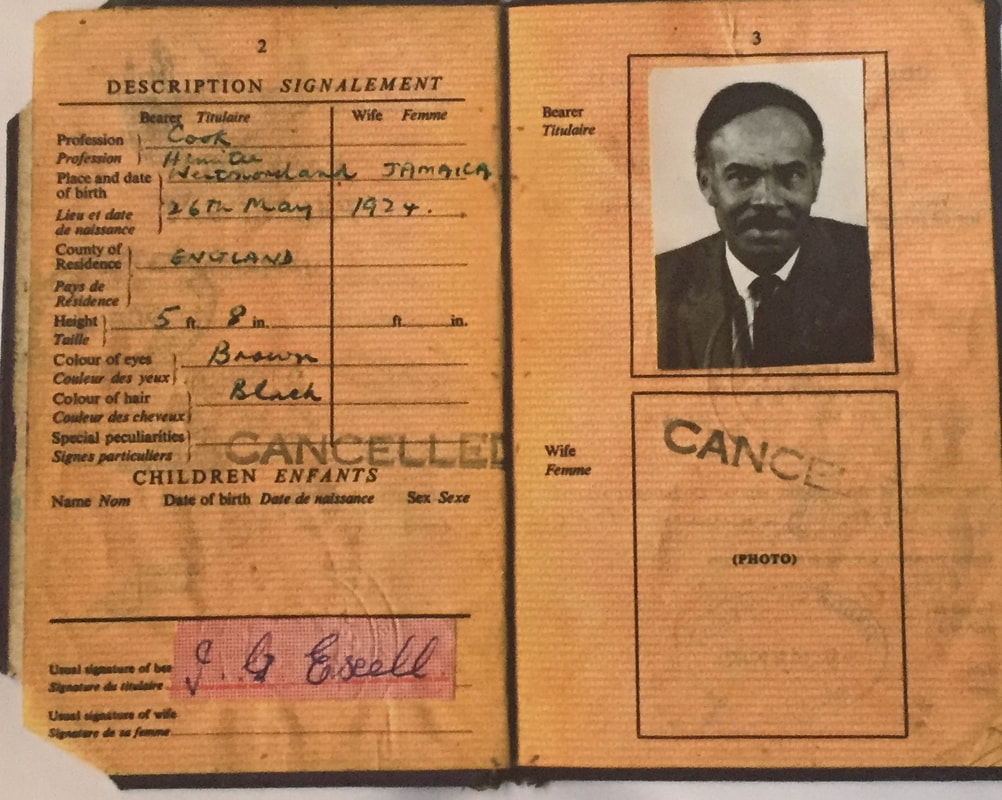 Exell's passport Footnotes
[1] Alec Gill, Nick the Cook: Hull’s black fisherman (Hull: The University of Hull, 2004), p.4 [2] Ibid, p. 5 [3] Ibid, p. 12 [4] Ibid, p. 12 [5] Ibid, p. 13 [6] Ibid, p. 14 [7] Ibid, p. 14 and 15 [8] Ibid, p. 24 [9] To read more about the Staxton Wyke consult the Hull Daily Mail, 31 August 2010, p. 3 [10] Ibid, p. 25 [11] Ibid, p. 27 [12] Ibid, p, 27 [13] Hull Daily Mail, 19 November 2014, p. 12 [14] Ibid, p. 28 and 29 [15] Ibid, p. 30 and 31
[1] Ancestry.com. England & Wales, Civil Registration Birth Index, 1916-2005 [database on-line]. Provo, UT, USA: Ancestry.com Operations Inc, 2008.
[2] Hull Daily Mail, 4 November 2017, p. 15 [3] Hull Daily Mail, 29 November 1949, p. 2 [4] Aberdeen Evening Express, 4, 6 and 7 December 1954, p. 2 and Fife Free Press & Kirkcaldy Guardian, 4 December 1954, p. 1/ [5] Hull Daily Mail, 4 November 2017, p. 15 [6] Hull Daily Mail, 5 June 2010, p. 3 [7] Hull Daily Mail, 4 November 2017, p. 15
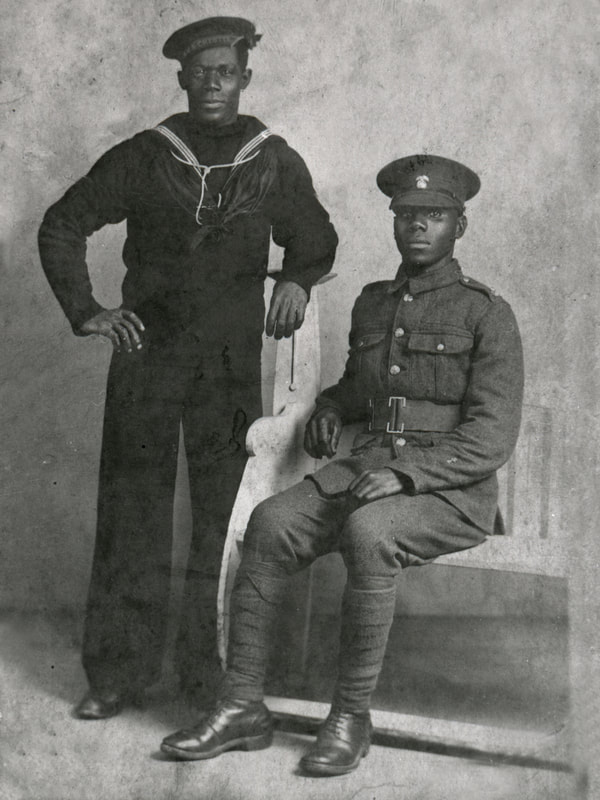
 Image: Royal British Legion and academics, Stephen Bourne, Ray Costello, Linda Hervieux, Mark Johnson and Andrea Levy among others, have all made valuable contributions to uncovering the lost history of Black Service Personnel during the First and Second World Wars. However, far more work needs to be done on a national, regional and local level to uncover further information about Black men and women within British military history from all time periods. Only when we acknowledge the bravery of white and non-white service personnel together, can we truly begin to understand and appreciate the sacrifices made by all during war. Black service personnel have had a long history in the British forces. Men such as John Lewis Friday were part of the British Army during the Napoleonic Wars. He, along with some of his white and Black counterparts, received the prestigious Waterloo Medal for their bravery on the battlefield. During World War One, soldiers of African descent were enlisted into regiments across Britain. Even predominantly white regiments often had Black servicemen in their battalions. In 1915, the Hull Soldiers Club gathered for an awards ceremony, in which a ‘coloured soldier’ of the East Yorkshire Regiment was given a prize for bravery. Another soldier of African descent who fought as part of the East Yorkshire Regiment was Theophilus Davis. He sadly died during the conflict and is commemorated on the Ploegsteert Memorial in Belgium (we will be bringing a larger story out on Davis soon so keep checking our weekly releases). Another soldier of African descent, Private Palmer Samson, who was born in Calabar around 1897, enlisted at Beverley during the First World War. We know very little about his life, other than that he was adopted by Susannah Wilson and lived with her at 10 Bolton Terrace, Hotham Street, Hull. Although he signed up in East Yorkshire, Samson ended up in the 1st Battalion of the Devonshire Regiment which fought on the front line in Belgium. Sadly, he was killed in action at the Battle of Broodseinde, near Ypres on 4 October 1917. It is probable that his adopted mother Susannah received Samson’s medals and memorial death plaque after the war to acknowledge his contribution to the conflict. Last month marked the centenary of his death.
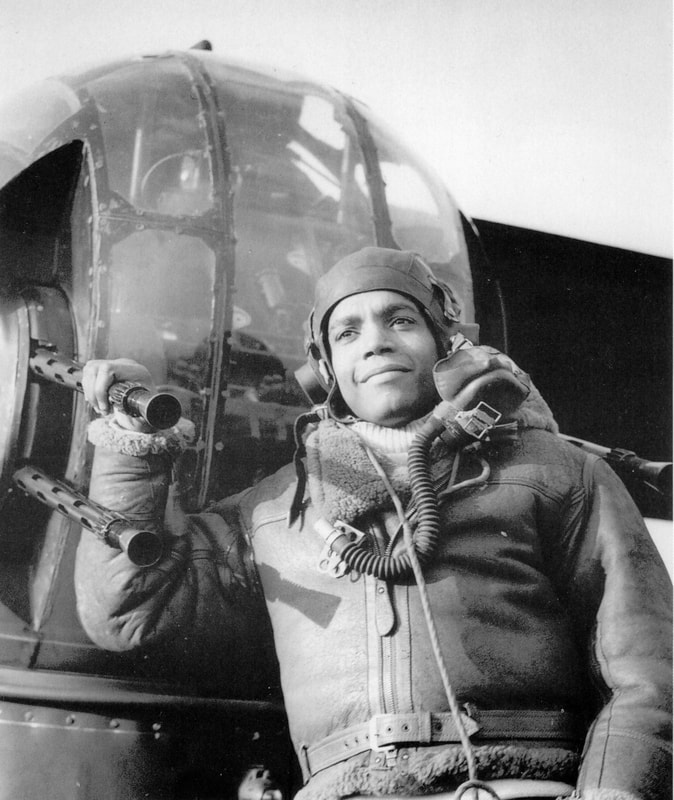
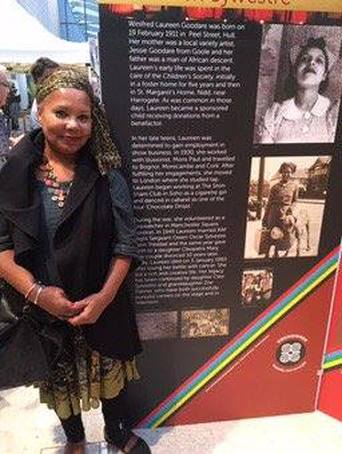
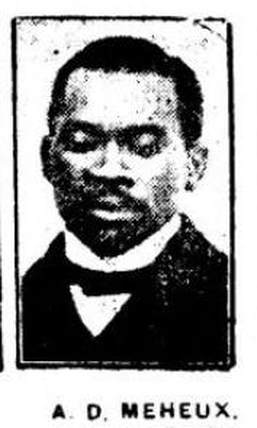
During World War Two, West Indian volunteers flocked from the colonies to join the RAF as pilots and ground staff. Many of these men trained in East Yorkshire, some losing their lives here such as Byron Martin, Wilfred Octavius Dawns, Vivian Florent and Patrick Constantine Marshall (click here to read our previous blog post on war graves). However, their contributions are often overlooked. As are the roles played by women of African descent during war, such as Liverpool-born Lilian Bailey/Bader, who also joined the WAAF becoming an Aircraftswomen First class, before she was promoted to Acting Corporal. 'Lest we forget' on this Remembrance Sunday, that people of different races from across the globe have fought for Britain during various military campaigns, many paying the ultimate price. During war, they stood shoulder to shoulder fighting for this country so let us celebrate, commemorate and remember them together. Below is a slideshow of images of some of the many Black servicemen and women who have links to the Hull and East Yorkshire region. To find out more about them click on each image to go to relevant pages on the project website. |
Follow usArchives
April 2023
Categories
All
|
 RSS Feed